Generating 10 talks in 10 minutes
At BrooklynJS in November 2019, I gave a lightning talk about using machine learning to generate talk ideas. I had scraped all the talk submissions from BrooklynJS's GitHub repository and trained an LSTM model using TensorFlow.js to learn the patterns and language of those submissions. The model generated new talk titles and descriptions that captured the quirky, technical, and often humorous tone of the BrooklynJS community.
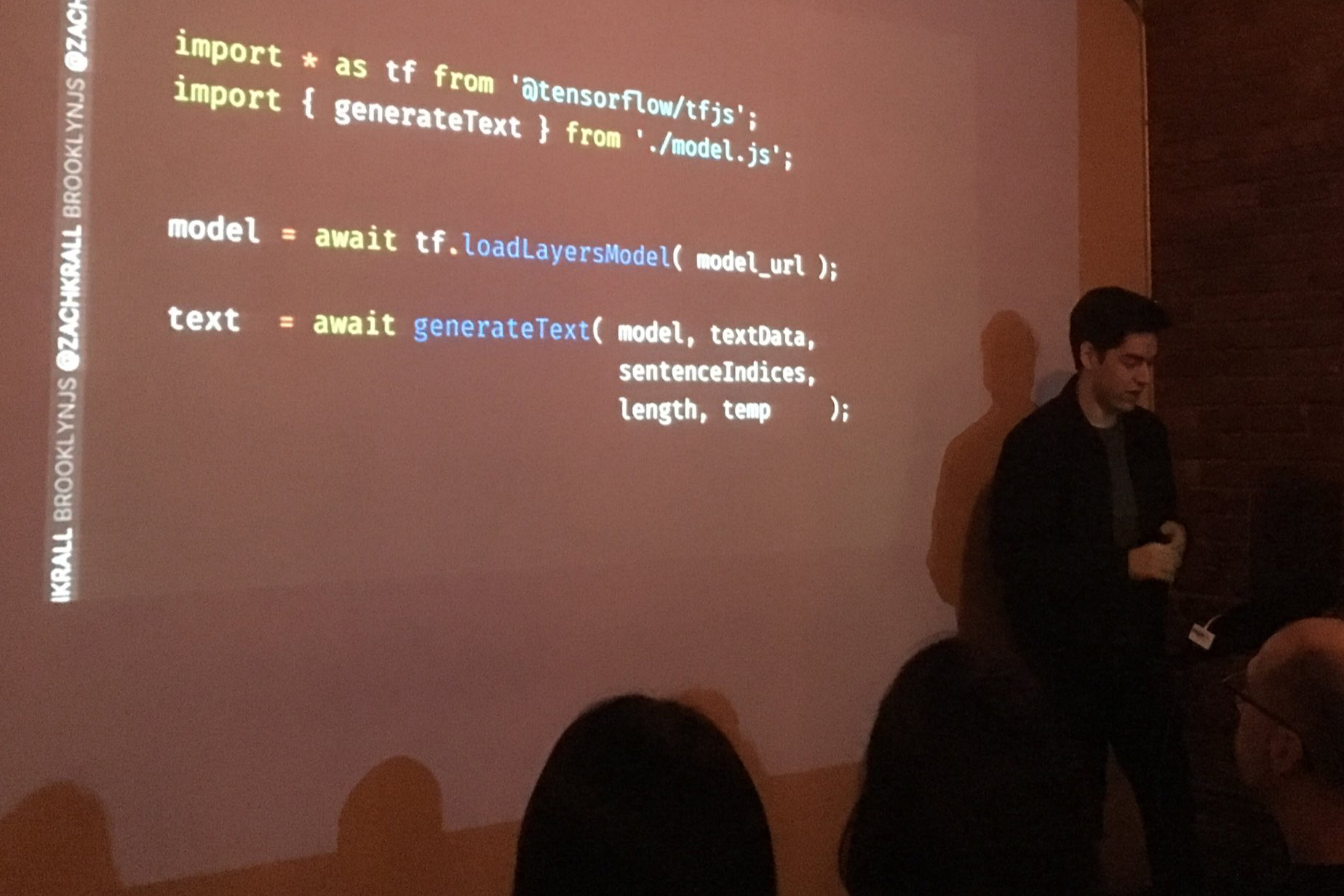
The project started as an experiment to see if I could use the browser to train a neural network without relying on external services or Python. TensorFlow.js made it possible to run the entire training pipeline client-side, which meant I could demonstrate the model generating talks in real-time during the presentation. The LSTM learned to combine technical terms, creative concepts, and the community's characteristic style, producing titles that felt both familiar and absurdly novel.
What made this particularly fitting for BrooklynJS was the meta-narrative: I was using code to generate ideas about code talks, presented at a code meetup. The generated talks ranged from plausible to delightfully nonsensical, and the audience seemed to enjoy seeing their own submission style reflected back through the lens of machine learning. It was a playful exploration of how AI can remix and reimagine community knowledge, and a demonstration that sophisticated machine learning doesn't always require complex infrastructure—sometimes a browser and some JavaScript is enough.